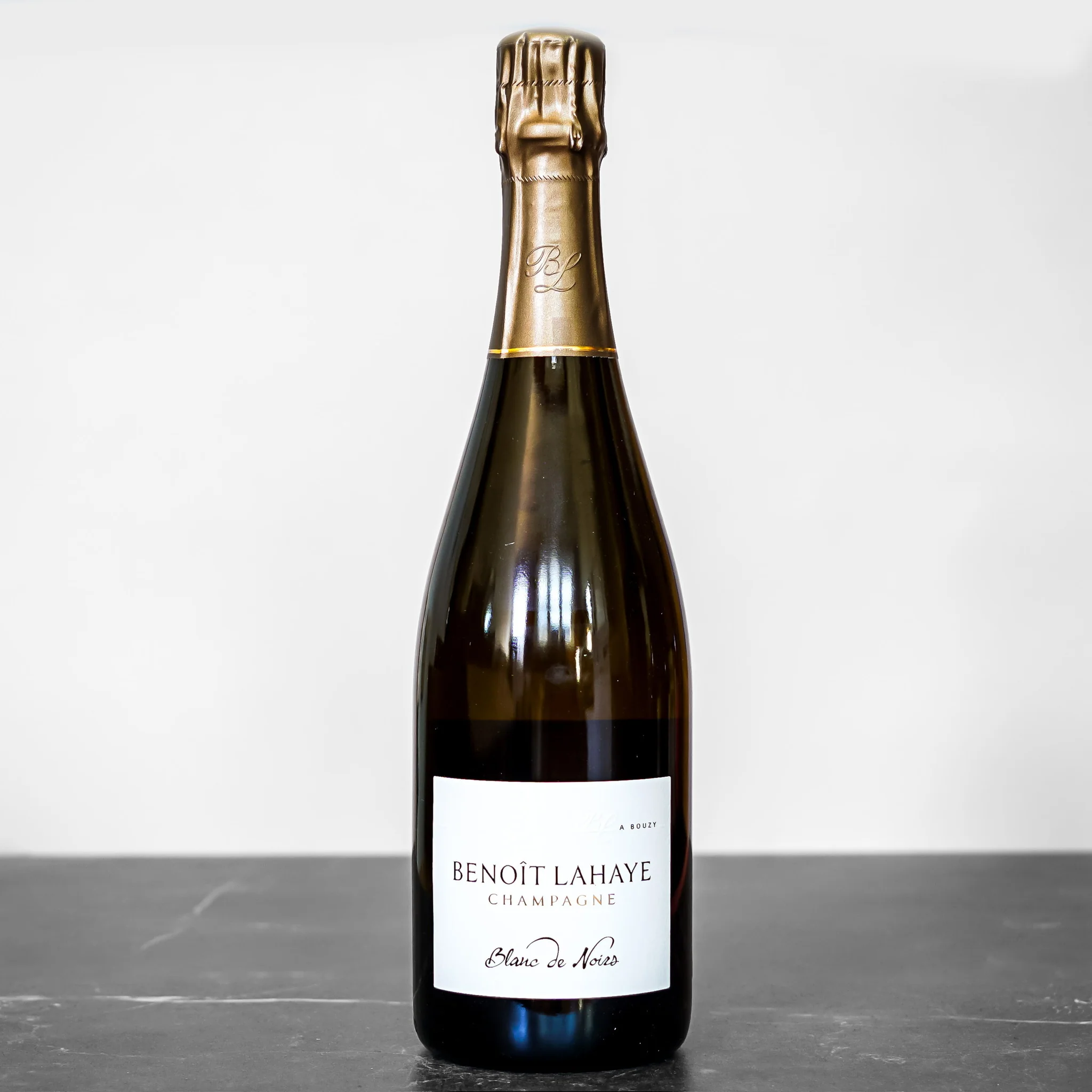
Blanc de Noirs
100% Pinot Noir from Bouzy (Les Vaux Betins and Les Hannepes specifically, both plots with deep soils), and Tauxières (a plot called Les Argentières with more chalk.) The vines were planted in 1960, 1980 and 1990. The grapes from each parcel are pressed separately. Bottling is without filtration and the dosage is 5 grams per liter, making it an extra brut. 666 cases are produced. Its dark-toned fruit is underlined by a stony minerality. Energetic and persistent all the way through to the finish.
Benoit Lahaye
Benoit Lahaye is located in Bouzy, a grand cru village in the Montagne de Reims. His family has been making Champagne there since the 1930s, and today he works in the winery with his wife Valérie and their two sons. The domaine, which covers a surface area of 4.8 hectares, is situated in the regions of Bouzy (3.2 hectares), Ambonnay (1 ha), and Tauxières (0.6 ha). Bouzy brings structure, power, and fruit to the wines while Ambonnay brings acidity and roundness. The estate is mainly planted with Pinot Noir (just under 90%) on south- and southwest-facing slopes. The vines average 35 to 40 years old. The total production is less than 40,000 bottles per year.
Lahaye uses only his own compost and organic manure to enrich his soil. Various herb infusions are also applied, along with other fermented extracts from plants and essential oils in order to combat plant disease. Since 2009, Lahaye has also been applying biodynamic principles to further improve the expression of his terroir and reveal the full potential of his soil and vines. He says that the switch to biodynamic practices has brought higher potential alcohol at harvest, but also higher acidity. His 9-year-old work horse Tamise, who became part of the family in 2010, leads Benoit around the vineyards, plowing the soil and spreading compost.
In 2010, the estate was certified biodynamic by Biodyvin. In the cellar, the work is as minimal as possible. The major part of the vinification is achieved in 225-liter barrels, without any chaptalization and using only natural yeasts. The wine spends 10 months on its lees without racking. All the wines go through 100% malolactic fermentation—with the biodynamic practices, Lahaye is not afraid of losing too much acidity but, more than anything, he is against stopping the malolactic by adding sulfur. The barrels are in a new above-ground chai that has large windows so that the wine sees the seasons before being put in bottle.
Original: $108.00
-70%$108.00
$32.40Product Information
Product Information
Shipping & Returns
Shipping & Returns
Description
100% Pinot Noir from Bouzy (Les Vaux Betins and Les Hannepes specifically, both plots with deep soils), and Tauxières (a plot called Les Argentières with more chalk.) The vines were planted in 1960, 1980 and 1990. The grapes from each parcel are pressed separately. Bottling is without filtration and the dosage is 5 grams per liter, making it an extra brut. 666 cases are produced. Its dark-toned fruit is underlined by a stony minerality. Energetic and persistent all the way through to the finish.
Benoit Lahaye
Benoit Lahaye is located in Bouzy, a grand cru village in the Montagne de Reims. His family has been making Champagne there since the 1930s, and today he works in the winery with his wife Valérie and their two sons. The domaine, which covers a surface area of 4.8 hectares, is situated in the regions of Bouzy (3.2 hectares), Ambonnay (1 ha), and Tauxières (0.6 ha). Bouzy brings structure, power, and fruit to the wines while Ambonnay brings acidity and roundness. The estate is mainly planted with Pinot Noir (just under 90%) on south- and southwest-facing slopes. The vines average 35 to 40 years old. The total production is less than 40,000 bottles per year.
Lahaye uses only his own compost and organic manure to enrich his soil. Various herb infusions are also applied, along with other fermented extracts from plants and essential oils in order to combat plant disease. Since 2009, Lahaye has also been applying biodynamic principles to further improve the expression of his terroir and reveal the full potential of his soil and vines. He says that the switch to biodynamic practices has brought higher potential alcohol at harvest, but also higher acidity. His 9-year-old work horse Tamise, who became part of the family in 2010, leads Benoit around the vineyards, plowing the soil and spreading compost.
In 2010, the estate was certified biodynamic by Biodyvin. In the cellar, the work is as minimal as possible. The major part of the vinification is achieved in 225-liter barrels, without any chaptalization and using only natural yeasts. The wine spends 10 months on its lees without racking. All the wines go through 100% malolactic fermentation—with the biodynamic practices, Lahaye is not afraid of losing too much acidity but, more than anything, he is against stopping the malolactic by adding sulfur. The barrels are in a new above-ground chai that has large windows so that the wine sees the seasons before being put in bottle.