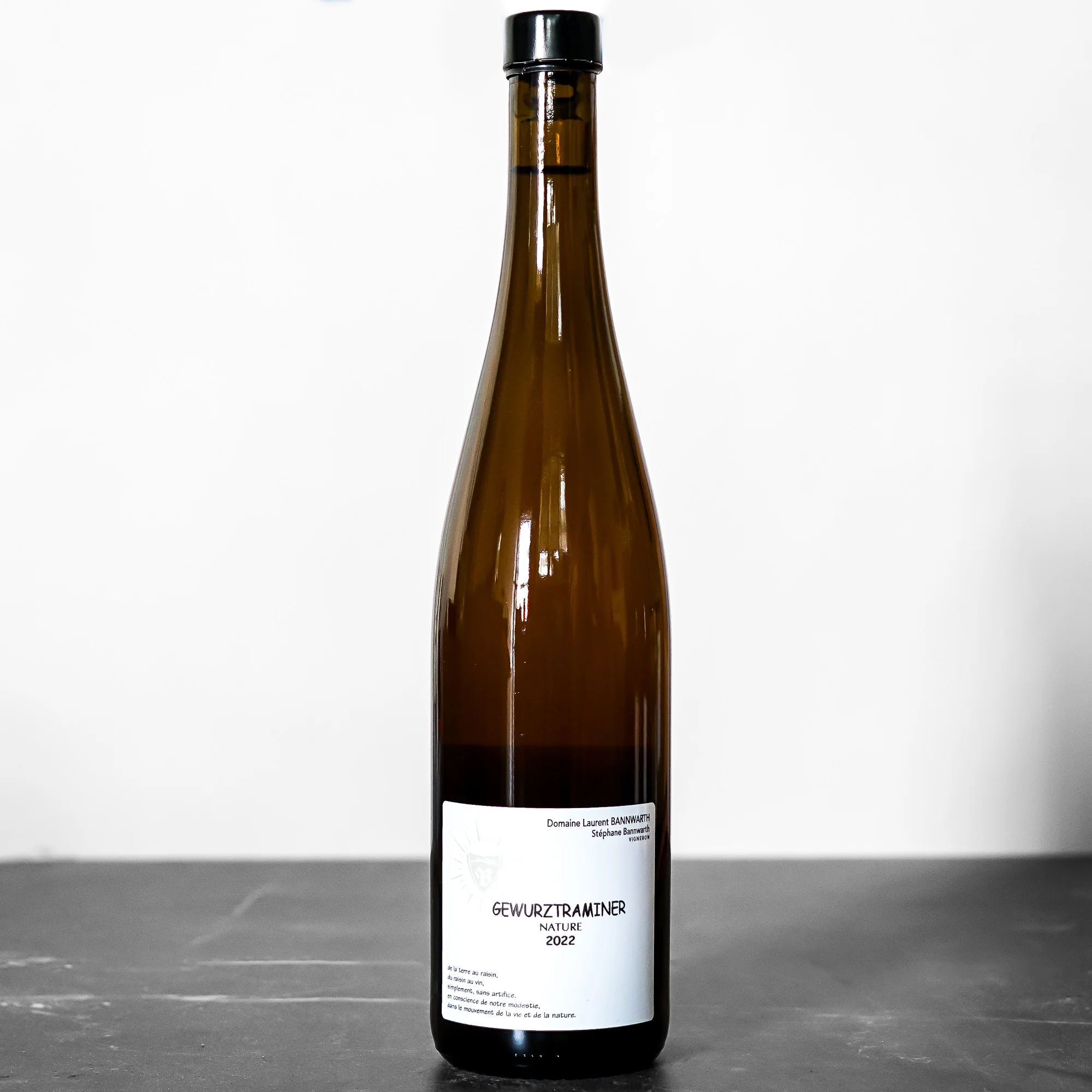
Gewurztraminer
The grapes are hand-harvested and carefully sorted in the vineyard, keeping only the ripe and healthy ones. Slow direct press, debourbage, followed by native fermentation in neutral foudre. Aged on its fine lees for 3 months, racked and bottled without fining or sulfur addition.
Laurent Bannwarth
Winemaking at Domaine Bannwarth doesn’t follow a strict set of rules. Rather than following formulas or trying to recreate styles of yesteryear, it's all about letting the vintage speak. Alsace isn’t exactly predictable — one year it’s cold and wet, the next it’s scorched earth. Each plot reacts differently, so instead of forcing things to fit a mold, Régine and her brother Stéphane work with what nature gives them. No dogma, no rigid playbook — just intuition. They harvest where the fruit is speaking the loudest. Some years that means a brand new cuvée comes into being. Other years, something gets left out entirely. If the material isn’t right, they simply don’t make the wine.
That fluid, responsive mindset also explains why there’s no cuvée vieilles vignes — even though some of the vines date back to the 1950s, planted by their father Laurent. They’re not chasing labels or prestige; a single vineyard might be bottled if the site speaks loudly enough (like their standout marine limestone parcel), but the goal is always to make wines that feel sympathique — expressive, honest, and generous — rather than systematic or self-important.
In the cellar, that same approach continues. Fermentations are all wild, and the wines are handled with a light touch — no additives, no interventions unless truly necessary. Most cuvées see a mix of vessels: glass-lined concrete, old foudres, whatever’s available and makes the most sense. The Muscat is the exception — always fermented in stainless to keep it sharp and precise.
Their bioclimatic cellar is dug into the ground, with riprap walls and an elliptical shape that encourages calm and natural movement. It’s a space that shares both energy and philosophy with their friend Christian Binner. With stable conditions and time on their side, the wines settle into themselves naturally. Most are bottled without sulfur, though a tiny addition might be made if the wine asks for it. Once again, it’s all about feel — not control.
Original: $38.00
-70%$38.00
$11.40Product Information
Product Information
Shipping & Returns
Shipping & Returns
Description
The grapes are hand-harvested and carefully sorted in the vineyard, keeping only the ripe and healthy ones. Slow direct press, debourbage, followed by native fermentation in neutral foudre. Aged on its fine lees for 3 months, racked and bottled without fining or sulfur addition.
Laurent Bannwarth
Winemaking at Domaine Bannwarth doesn’t follow a strict set of rules. Rather than following formulas or trying to recreate styles of yesteryear, it's all about letting the vintage speak. Alsace isn’t exactly predictable — one year it’s cold and wet, the next it’s scorched earth. Each plot reacts differently, so instead of forcing things to fit a mold, Régine and her brother Stéphane work with what nature gives them. No dogma, no rigid playbook — just intuition. They harvest where the fruit is speaking the loudest. Some years that means a brand new cuvée comes into being. Other years, something gets left out entirely. If the material isn’t right, they simply don’t make the wine.
That fluid, responsive mindset also explains why there’s no cuvée vieilles vignes — even though some of the vines date back to the 1950s, planted by their father Laurent. They’re not chasing labels or prestige; a single vineyard might be bottled if the site speaks loudly enough (like their standout marine limestone parcel), but the goal is always to make wines that feel sympathique — expressive, honest, and generous — rather than systematic or self-important.
In the cellar, that same approach continues. Fermentations are all wild, and the wines are handled with a light touch — no additives, no interventions unless truly necessary. Most cuvées see a mix of vessels: glass-lined concrete, old foudres, whatever’s available and makes the most sense. The Muscat is the exception — always fermented in stainless to keep it sharp and precise.
Their bioclimatic cellar is dug into the ground, with riprap walls and an elliptical shape that encourages calm and natural movement. It’s a space that shares both energy and philosophy with their friend Christian Binner. With stable conditions and time on their side, the wines settle into themselves naturally. Most are bottled without sulfur, though a tiny addition might be made if the wine asks for it. Once again, it’s all about feel — not control.